AWS vs Google Cloud vs Azure for Cloud-Native and Kubernetes
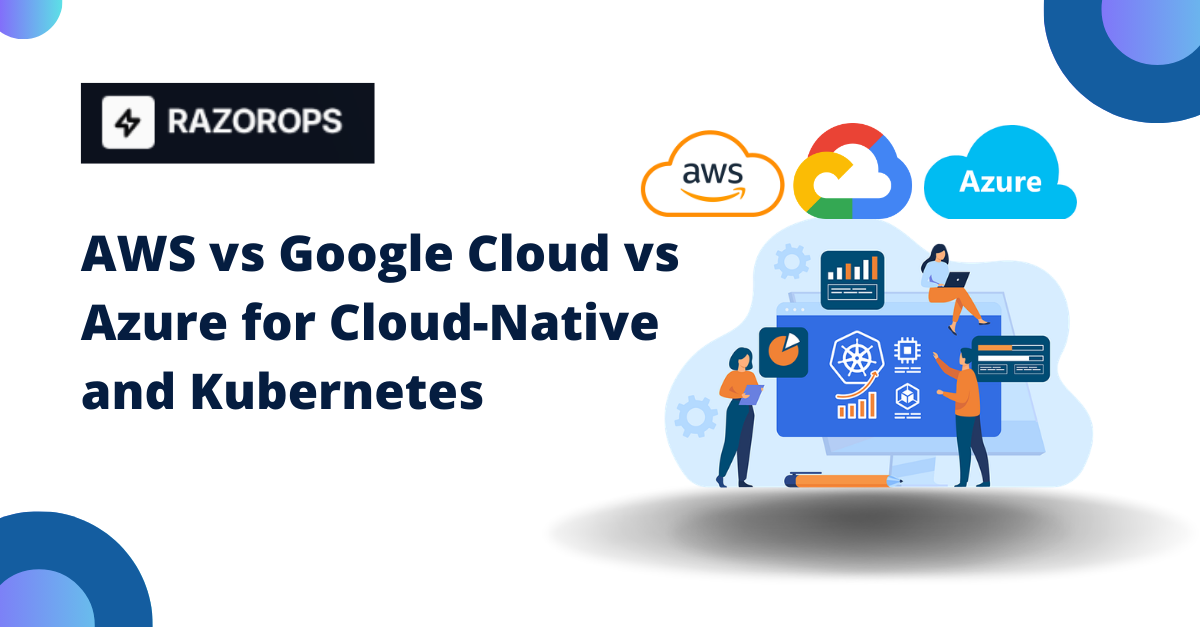
Cloud adoption is no longer about “moving to the cloud.” It’s about building cloud-native platforms that are scalable, observable, automated, and Kubernetes-driven.
This guide provides a deep comparison of Amazon Web Services, Google Cloud and Microsoft Azure with a focus on Kubernetes, platform engineering, DevOps, and modern workloads, aligned with standards pioneered by the Cloud Native Computing Foundation.
What “Cloud-Native” Means in 2026
Cloud-native architecture is built on:
- Containers (OCI images)
- Kubernetes orchestration
- Immutable infrastructure
- GitOps & CI/CD automation
- Service mesh & observability
- Autoscaling + cost optimization
- API-driven infrastructure (IaC)
All three clouds now provide fully managed Kubernetes ecosystems, but their philosophy differs:
| Cloud | Philosophy |
|---|---|
| AWS | Infrastructure-first, extremely flexible, best for custom platforms |
| GCP | Kubernetes-first, opinionated, developer-friendly |
| Azure | Enterprise-first, Microsoft ecosystem integration |
Managed Kubernetes Comparison
| Capability | AWS | Google Cloud | Azure |
|---|---|---|---|
| Managed Kubernetes | EKS | GKE | AKS |
| Who built Kubernetes originally? | External adoption | Native DNA | External adoption |
| Control Plane Maturity | Very stable | Most feature-rich | Enterprise-integrated |
| Autopilot Mode | EKS Auto Mode | GKE Autopilot (leader) | AKS Automatic |
| Best For | Platform teams | Dev velocity | Enterprise IT |
| Upgrade Experience | Manual control | Most automated | Balanced |
| Networking Model | VPC-native | Pod-native (best) | Azure CNI |
| Multi-Cluster | AWS Fleet | GKE Fleet | Azure Fleet Manager |
- GKE still leads in Kubernetes innovation
- EKS gives maximum infra flexibility
- AKS fits enterprise governance models
Equivalent Cloud-Native Services Mapping (Side-by-Side)
1. Core Infrastructure
| Capability | AWS | GCP | Azure |
|---|---|---|---|
| Virtual Machines | EC2 | Compute Engine | Virtual Machines |
| Autoscaling | Auto Scaling Groups | Managed Instance Groups | VM Scale Sets |
| Load Balancer | ALB/NLB | Cloud Load Balancing | Azure Load Balancer |
| VPC Networking | VPC | VPC | Virtual Network |
2. Containers & Kubernetes Ecosystem
| Capability | AWS | GCP | Azure |
|---|---|---|---|
| Managed Kubernetes | EKS | GKE | AKS |
| Container Registry | ECR | Artifact Registry | ACR |
| Serverless Containers | Fargate | Cloud Run | Container Apps |
| Kubernetes Cost Mgmt | Karpenter | GKE Autopilot | AKS KEDA |
| Service Mesh | App Mesh | Anthos Service Mesh | Open Service Mesh |
| Config/GitOps | AWS Proton / ArgoCD | Config Sync | Flux (native support) |
3. DevOps & Platform Engineering
| Capability | AWS | GCP | Azure |
|---|---|---|---|
| CI/CD | CodePipeline | Cloud Build | Azure DevOps |
| Artifact Mgmt | CodeArtifact | Artifact Registry | Azure Artifacts |
| IaC Native | CloudFormation | Deployment Manager | ARM/Bicep |
| Terraform Support | Excellent | Excellent | Excellent |
| GitOps Integration | Manual-first | Strong native | Strong enterprise |
4. Observability & SRE Tooling
| Capability | AWS | GCP | Azure |
|---|---|---|---|
| Metrics | CloudWatch | Cloud Monitoring | Azure Monitor |
| Logging | CloudWatch Logs | Cloud Logging | Log Analytics |
| Tracing | X-Ray | Cloud Trace | App Insights |
| Managed Prometheus | Amazon Managed Prometheus | Native Managed Prometheus | Azure Managed Prometheus |
| SLO Tooling | Manual | Native SLO | Integrated |
GCP leads in true SRE-style observability.
5. Data & Cloud-Native Storage
| Capability | AWS | GCP | Azure |
|---|---|---|---|
| Object Storage | S3 | Cloud Storage | Blob Storage |
| Managed SQL | RDS | Cloud SQL | Azure SQL |
| NoSQL | DynamoDB | Firestore | Cosmos DB |
| Analytics | Redshift | BigQuery | Synapse |
| Streaming | Kinesis | Pub/Sub | Event Hub |
BigQuery still dominates cloud-native analytics workflows.
6. Serverless & Event-Driven
| Capability | AWS | GCP | Azure |
|---|---|---|---|
| Functions | Lambda | Cloud Functions | Azure Functions |
| Event Bus | EventBridge | Eventarc | Event Grid |
| Workflow | Step Functions | Workflows | Logic Apps |
7. Architecture Philosophy Differences
AWS — “Build Your Own Platform”
Best for:
- Custom internal developer platforms
- Multi-account isolation
- Fine-grained scaling control
- Complex networking/security
Tradeoff: More operational decisions required.
Google Cloud — “Kubernetes Is the Platform”
Best for:
- SaaS companies
- AI/ML + containers
- Fast developer onboarding
- SRE-driven orgs
Tradeoff: Less infra-level customization.
Azure — “Enterprise Cloud Native”
Best for:
- Enterprises migrating from Microsoft stack
- Hybrid cloud (on-prem → cloud)
- Governance-heavy environments
- .NET + Windows workloads
Tradeoff: Slower innovation cadence vs GCP.
8. Pricing Model Comparison (Kubernetes Workloads)
| Area | AWS | GCP | Azure |
|---|---|---|---|
| Control Plane Cost | Charged | Free (Autopilot bundled) | Free |
| Autoscaling | Karpenter (very powerful) | Native Autopilot | VMSS-based |
| Spot Pricing | Mature | Strong | Improving |
| FinOps Tooling | Cost Explorer | Built-in Recommender | Cost Management |
| Best Cost Efficiency | Tuned manually | Automatic | Enterprise optimized |
9. Security Model Comparison
| Feature | AWS | GCP | Azure |
|---|---|---|---|
| IAM Granularity | Most advanced | Simpler | Enterprise RBAC |
| Workload Identity | IRSA | Native & easiest | Managed Identity |
| Policy Engine | AWS SCP | Organization Policy | Azure Policy |
| Zero-Trust | Manual build | Strong defaults | Deep AD integration |
10. Which Cloud Is Best for Kubernetes-First Companies?
| Use Case | Winner |
|---|---|
| Startup building SaaS on Kubernetes | GCP |
| Large-scale platform engineering | AWS |
| Enterprise modernization | Azure |
| Multi-cloud Kubernetes | GCP + AWS combo |
| AI + Cloud-Native convergence | GCP |
| Regulated workloads | Azure |
| Extreme infra control | AWS |
11. 2026 Trends Across All Three Clouds
- Kubernetes is becoming invisible infrastructure
- Serverless containers replacing VM-heavy workloads
- AI workloads tightly integrated with K8s scheduling
- Platform Engineering replacing DevOps silos
- FinOps automation becoming mandatory
- Multi-cluster governance now standard
- GitOps is the default deployment model
12. Final Verdict
There is no single winner anymore.
- Choose AWS if you want maximum control and scale engineering
- Choose GCP if you want true cloud-native velocity
- Choose Azure if you want enterprise + hybrid Kubernetes
The best organizations today are cloud-agnostic but Kubernetes-standardized.
13. Top 20 Interview FAQs (Cloud-Native + Kubernetes)
1. Why is Kubernetes central to cloud-native architecture?
It abstracts infrastructure differences, enabling portability across clouds.
2. Difference between EKS, GKE, and AKS?
They are managed Kubernetes services with different automation, networking, and ecosystem strengths.
3. Which cloud provides the most “native” Kubernetes experience?
GCP, because Kubernetes originated from Google’s internal Borg system.
4. What is Autopilot mode?
A fully managed model where the cloud handles node provisioning and scaling automatically.
5. How does AWS Karpenter differ from Cluster Autoscaler?
Karpenter provisions right-sized nodes dynamically instead of scaling predefined node groups.
6. Which cloud is best for multi-cluster management?
GCP’s fleet model is most mature.
7. How do clouds implement workload identity?
IAM roles mapped to Kubernetes service accounts (IRSA / Workload Identity / Managed Identity).
8. What is cloud-native observability?
Metrics, logs, and traces integrated with autoscaling and SLO-driven operations.
9. Why is serverless containers adoption increasing?
They eliminate node management while retaining container flexibility.
10. What is GitOps?
Deployment model where Git is the single source of truth for infrastructure and apps.
11. Which cloud is strongest for FinOps?
AWS provides deepest cost visibility; GCP provides strongest automation.
12. How do clouds differ in networking models?
AWS uses VPC-centric networking; GCP offers pod-native networking; Azure integrates enterprise VNets.
13. What is a service mesh’s role?
Handles traffic management, mTLS security, and observability between microservices.
14. How do managed Kubernetes services handle upgrades?
GKE automates most upgrades; EKS offers more manual control; AKS balances both.
15. What are cloud-native storage patterns?
Object storage + CSI volumes + distributed databases.
16. Why is multi-cloud becoming common?
To avoid vendor lock-in and optimize workload placement.
17. What skills should a platform engineer know today?
Kubernetes, Terraform, observability, networking, and cost optimization.
18. What replaces traditional DevOps pipelines?
GitOps + platform APIs + internal developer portals.
19. How does security change in cloud-native systems?
Identity becomes the perimeter (Zero-Trust model).
20. What is the future of Kubernetes in cloud providers?
It will become a hidden control plane—developers interact with platforms, not clusters.
Enjoyed this article? Share it.